
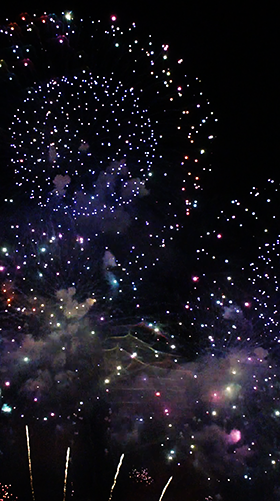

Biwako Fireworks Festival
A Symphony of Fire and Water: The Biwako Otsu Fireworks Festival
While the quiet temples and traditional geisha districts of Kyoto capture the soul of ancient Japan, there is one summer night when the sky above the neighboring Lake Biwa ignites in a display of modern power and ethereal beauty.
If you find yourself in the Kyoto area during early August, you have the chance to witness the Biwako Otsu Fireworks Festival (Biwako Dai-Hanabi Taikai). It is not just a fireworks show; it is a cultural phenomenon that transforms Japan’s largest lake into a colossal, liquid mirror for millions of sparks.
The Canvas of the Great Lake
The Japanese word for fireworks is Hanabi, which literally translates to “fire flowers.” At Lake Biwa, these flowers bloom on a scale that is impossible to replicate in the narrow streets of a city.
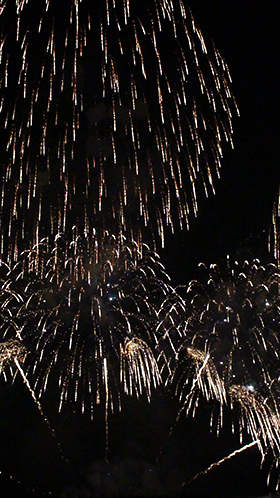
The setting is the Otsu port area, where the vast, dark expanse of the lake provides a natural, infinite stage. Unlike fireworks displays set against a city skyline, the Biwako festival utilizes the water itself. Specially designed fireworks are launched at an angle, exploding just above the surface to create perfect semicircles of light. The reflection on the water doubles the intensity, wrapping the audience in a 360-degree world of shimmering gold, emerald, and violet.
A Night of Summer Tradition
Attending the Biwako fireworks is a deep dive into the heart of a Japanese summer. As the sun begins to set over the Hiei mountains, the lakeside comes alive with a festive energy that is contagious.
You will see thousands of people dressed in Yukata (summer cotton kimonos), their colorful patterns echoing the floral explosions soon to appear in the sky. The air is filled with the tempting aromas of Yatai (food stalls)—the smoky scent of Yakisoba, the sweet glaze of Takoyaki, and the sound of ice being shaved for Kakigori.
For an international traveler, this is the ultimate “local” experience. It is a moment where the formal boundaries of Japanese society soften, replaced by shared gasps of “Tamaya!” (an ancient shout of praise for firework makers) and the collective glow of ten thousand smartphone screens trying to capture the impossible.
The Power and the Grace
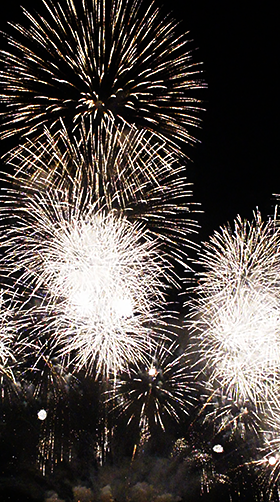
The craftsmanship behind the Biwako fireworks is legendary. Each shell is a handcrafted work of art, some taking months to assemble. The show is meticulously choreographed to music, featuring approximately 10,000 fireworks launched over the course of an hour.
The finale is a sensory overload. Known as the “Starmines,” these rapid-fire sequences fill the entire horizon, launching hundreds of shells per second until the night sky turns as bright as noon. The deep thuds of the largest shells don’t just reach your ears; you feel the vibration in your chest—a heartbeat shared with the 300,000 people standing beside you. It is a display of technical precision and artistic passion that leaves even the most seasoned travelers speechless.
Why Visit Biwako Otsu Now?
Kyoto in the summer can be intensely hot and humid. The Biwako fireworks offer a literal and metaphorical breath of fresh air. The lake breeze provides a cooling respite, and the sheer scale of the event offers a dramatic contrast to the intimate, quiet beauty of Kyoto’s Zen gardens.
It is a reminder that Japanese culture is not just about the past—it is about the celebration of the present moment (Ichigo Ichie). The fireworks are beautiful precisely because they are fleeting. They represent the peak of summer, a burst of joy that disappears into the night, leaving only the moonlight reflecting on the quiet waves of the lake.
Travel Tips for the Best Experience
-
The Yukata Experience: Consider renting a Yukata in Kyoto or Otsu for the day. Not only will you look the part, but the light fabric is the most comfortable way to endure the summer heat.
-
Paid Seating vs. Free Areas: While there are free viewing areas, they become crowded very early. For the best view of the water-surface fireworks, look into reserved seating tickets (usually sold in advance) to ensure a comfortable spot.
-
Stay Hydrated: Japanese summers are no joke. Carry plenty of water and a traditional folding fan (Sensu) to keep cool while waiting for the show to begin.
-
The Magic Hour: Arrive a few hours before the 7:30 PM start. Watching the sky turn purple over the lake while the festival lights begin to twinkle is a highlight in itself.
Access
・About a 10-minute train ride from Kyoto Station (get off at JR Otsu Station and walk about 15 minutes.)
・About a 40-minute ride from Osaka Station (get off at JR Otsu Station and walk about 15 minutes.)
Click here for Biwa Lake cruise details and reservations.

Nobunaga’s Hiding Rock