Kutsuki Ichiba
The Valley of the Golden Exile: Stepping into Kutsuki Ichiba, the Samurai Haven on the Mackerel Highway
If you stand at Demachiyanagi in Kyoto and head directly north into the mountains, you will follow a historic river valley cutting straight through the misty peaks. This is the Saba Kaido (The Mackerel Highway)—an ancient trade route where brave porters ran day and night to carry fresh seafood and mackerel from the Sea of Japan to the imperial tables of Kyoto.
Deep within this valley lies Kutsuki Ichiba, a hidden post-town that feels entirely frozen in time. This is not just a place where fish was carried; it was a sanctuary where emperors’ generals sought refuge, and where the most famous samurai in history narrowly escaped with his life. For travelers in Kyoto looking for an authentic journey into Japan’s deep interior, this mountain haven is a living time capsule.
The Valley That Saved Nobunaga and Shoguns
To understand Kutsuki Ichiba, you must understand the Kutsuki Clan. This remarkable samurai family accomplished a feat nearly unmatched in Japanese history: they ruled this exact mountain valley for over 600 years, from the Kamakura period all the way to the Meiji Restoration. In all of Japan, only the legendary Shimazu clan of Satsuma managed to hold onto their ancestral land for so long without being relocated by changing rulers.
Because the Kutsukis were famously loyal and their valley was an unassailable mountain fortress, it became the ultimate shelter during times of war. When bloody rebellions tore Kyoto apart during the Muromachi period, both the 12th and 13th Ashikaga Shoguns fled the capital and established temporary governments right here in this valley.
Most famously, in the year 1570, the legendary warlord Oda Nobunaga was trapped in the north when his ally, Azai Nagamasa, suddenly betrayed him. Facing certain death, Nobunaga staged a desperate, historic retreat back to Kyoto through the treacherous Kutsuki valley. The lord of the valley, Kutsuki Mototsuna, made a choice that changed the course of history: instead of capturing Nobunaga, he protected him and guided him safely back to Kyoto. If not for this valley and its lords, the era of the Unifiers would have ended in these very mountains.
Walking the Lines of Medieval Strategy
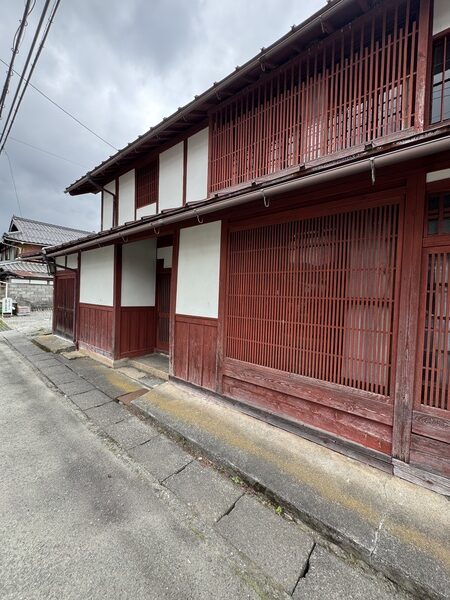
Walking down the quiet main street of Kutsuki Ichiba today, the layout of the town tells a story of medieval defense. As you stroll past the traditional Machiya (townhouses), you will suddenly hit a sharp, right-angle turn in the road known as Kaimagari (Key-Bend).
This deliberate zig-zag in the street was engineered during the samurai era to prevent invading forces or horse-riding assassins from having a clear line of sight through the town. The architectural details are beautifully preserved: traditional flat-front townhouses, weathered wooden siding, and a few rare, thatched-roof homesteads that have stood for generations. The air here carries the scent of mountain cedar and the ancient dignity of a place that was once a vital crossroads of survival.
A Modern Oasis in a Mountain Deep
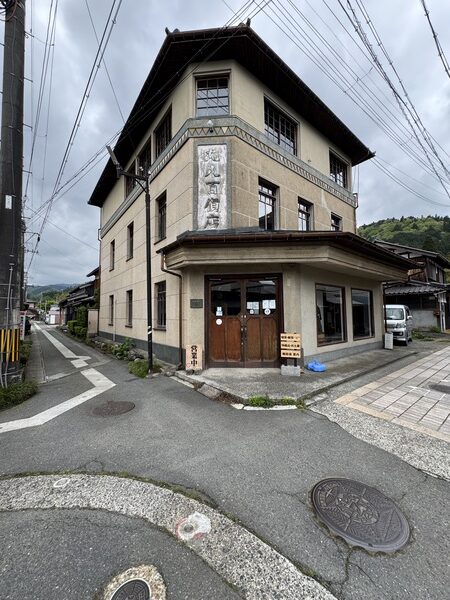
Right in the center of this historic street stands a striking architectural surprise: the Maruhachi Department Store (Maruhachi Hyakkaten). Built in 1933 (Showa 8), this elegant, three-story wooden building is registered as a National Tangible Cultural Property.
With its retro, early-20th-century design, it feels wonderfully out of place in a deep mountain valley. Its grand scale serves as a beautiful testament to just how wealthy and bustling this post-town was, acting as a vibrant hub where merchants, travelers, and mountain locals traded goods. Today, it stands as a charming symbol of the town’s enduring vitality, bridging the gap between medieval defense and modern community life.
Why Visit Kutsuki Ichiba Now?
For a traveler based in Kyoto, Kutsuki Ichiba offers the ultimate “Hidden Frontier.” While Kyoto’s narrow alleys are famous, Kutsuki gives you the vast scale of Japan’s mountain history.
It is a place to escape the modern world and connect with a landscape of absolute loyalty and survival. Standing at the Kaimagari bend, looking up at the ridge lines that saved the life of Japan’s greatest unifier, you will experience the raw, authentic pulse of the samurai era. If you seek a destination where history is etched into the very shape of the roads and the stones of the valley, Kutsuki Ichiba is calling.
Click here for Biwa Lake cruise details and reservations.