Lake Yogo
The Mirror of Destiny: Uncovering the Myths and Magic of Lake Yogo
If you have gazed upon the shimmering waters of the Kamo River in Kyoto and wondered where the city’s ancient legends began, there is a place further north that holds the answers in its emerald depths. Tucked away behind a screen of mountains at the northernmost tip of Shiga Prefecture lies Lake Yogo (Yogoko).
Known as the “Mirror of the Sky,” this quiet, mystical lake is the smaller, enigmatic sibling of the great Lake Biwa. It is a place where the line between the heavens and the earth blurs, and where Japan’s oldest myths still feel like a living reality.
The Mirror of the Sky
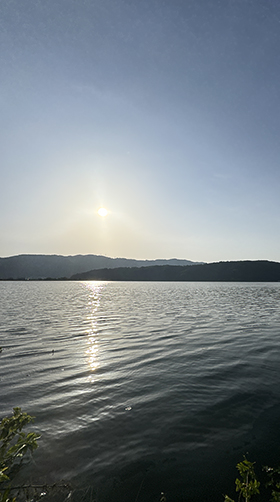
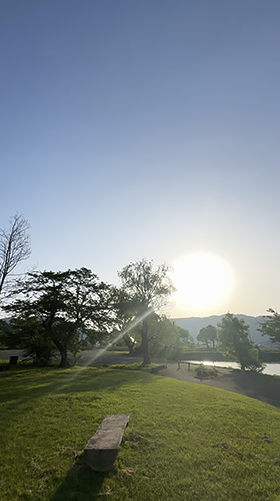
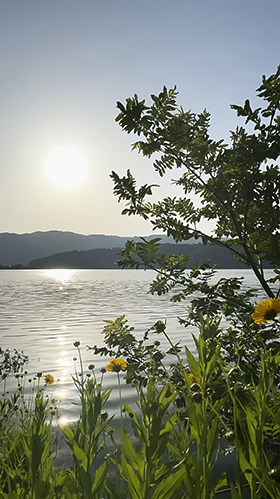
The most striking feature of Lake Yogo is its absolute stillness. Because it is surrounded by steep mountains that block the wind, the surface of the lake often becomes a perfect, flawless mirror.
On a clear day, the entire mountain range and the drifting white clouds are reflected in the water with such clarity that it is difficult to tell where the shore ends and the reflection begins. This natural phenomenon has earned it the nickname “The Salar de Uyuni of Japan.” For the traveler, it offers a visual serenity that is rare in our modern world—a chance to see the sky twice and to stand in a landscape that feels as though it has been suspended in glass.
The Legend of the Swan Maiden
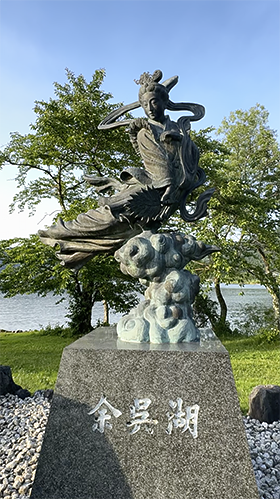
Lake Yogo is not just a geological wonder; it is a landscape of folklore. It is famously known as the setting for the Hagoromo (Celestial Robe) Legend.
According to ancient tales, eight heavenly maidens once descended from the sky in the form of swans to bathe in the cool waters of Lake Yogo. A local man, captivated by their beauty, hid one of their celestial robes, preventing the youngest maiden from returning to the heavens. She eventually stayed, married him, and became the mother of a lineage that shaped the region’s history.
As you walk the 6-kilometer path around the lake, you will find the ancient “Willow of the Celestial Robe” (Hagoromo no Yanagi), where the maiden is said to have hung her dress. Standing beneath its silver-green leaves, looking out over the silent water, the boundary between myth and reality feels thin indeed.
The Silent Witness to Battle
While the lake is a place of peace today, its waters once reflected the fires of the samurai era. Overlooking Lake Yogo is Mt. Shizugatake, the site of one of the most pivotal battles in Japanese history (1583).
It was here that Toyotomi Hideyoshi defeated his rival Shibata Katsuie, effectively deciding who would become the next unifier of Japan. Legend tells of warriors who, in their final moments, looked down at the mirror-like surface of Lake Yogo to find a moment of Zen before the end. The contrast between the violent history of the surrounding ridges and the eternal calm of the lake below gives the area a profound, poignant energy.
Why Visit Lake Yogo Now?
For a traveler based in Kyoto, Lake Yogo offers the ultimate “Atmospheric Escape.” While the Arashiyama bamboo groves are beautiful, they are shared with thousands. At Lake Yogo, you are often alone with the elements.
It is a place of seasonal wonders:
-
Spring: Thousands of yellow mustard flowers (Nanohana) and cherry blossoms bloom along the banks, creating a golden halo around the blue water.
-
Winter: The lake becomes a monochrome masterpiece, with snow-capped mountains and the unique sight of local fishermen huddling in small huts to catch Wakasagi (smelt) through the ice.
Lake Yogo is for the traveler who seeks the “Silent Japan.” It is for the poet, the photographer, and the soul-searcher. It is a place to breathe, to reflect, and to lose yourself in a story that began a thousand years ago.
Travel Tips for the Reflective Traveler
-
The Lakeside Loop: The 6km path around the lake is flat and perfect for a leisurely walk or a bicycle ride. It takes about 80–90 minutes to walk, offering changing perspectives of the “Mirror” at every turn.
-
Mt. Shizugatake Lift: Take the nearby chairlift up to the Shizugatake ridge. From the summit, you can see both Lake Biwa and Lake Yogo at the same time—a “Two-Lake View” that is considered one of the most beautiful panoramas in Japan.
-
Local Flavors: This region is famous for fermented foods. If you are adventurous, try the local Funazushi (ancient fermented sushi), or enjoy the fresh Wakasagi tempura during the winter months.
-
The Best Light: Arrive in the early morning or stay until sunset. The “Mirror” effect is strongest when the sun is low, casting a golden or purple glow over the perfectly still water.
Access: A ten-minute walk from JR Yogo Station
Click here for Biwa Lake cruise details and reservations.

Nobunaga’s Hiding Rock